If you’re a marketer, blogger, or business owner who just spent three months crafting a beautifully written, keyword-optimised piece of content, only to watch your traffic quietly flatten, and you’re doing everything right by old SEO standards, then what exactly is happening? Well, let me introduce you to the plot twist: search isn’t just search anymore. AI has entered the chat, and it’s literally rewriting the rules of how people find information online.
Welcome to the era of Answer Engine Optimisation, or AEO.
Also Read: From 10k to 300k Monthly Visitors: How We Scaled Beato’s Traffic by 30x
So, What Actually Is Answer Engine Optimisation (AEO)?
Okay, so let’s start at the beginning. According to Conductor, Answer Engine Optimisation (AEO) is the process of optimising your content’s structure and topical authority so it’s seen as the definitive response in AI-powered search. In plain English? It’s about making sure that when someone asks ChatGPT, Perplexity, Google’s AI Overview or Claude, your content is the one they pull out of the digital hat and serve up as the answer.
Think of traditional SEO as trying to get a great seat at a restaurant. AEO is becoming the chef whose dish gets described in the review. Currently, the goal has shifted from “rank on page one” to “be the answer itself.” So basically, rather than sending users on a click-trail across ten different websites, these tools do the reading for them and present one answer.
Why Is Everyone Suddenly Talking About AEO?
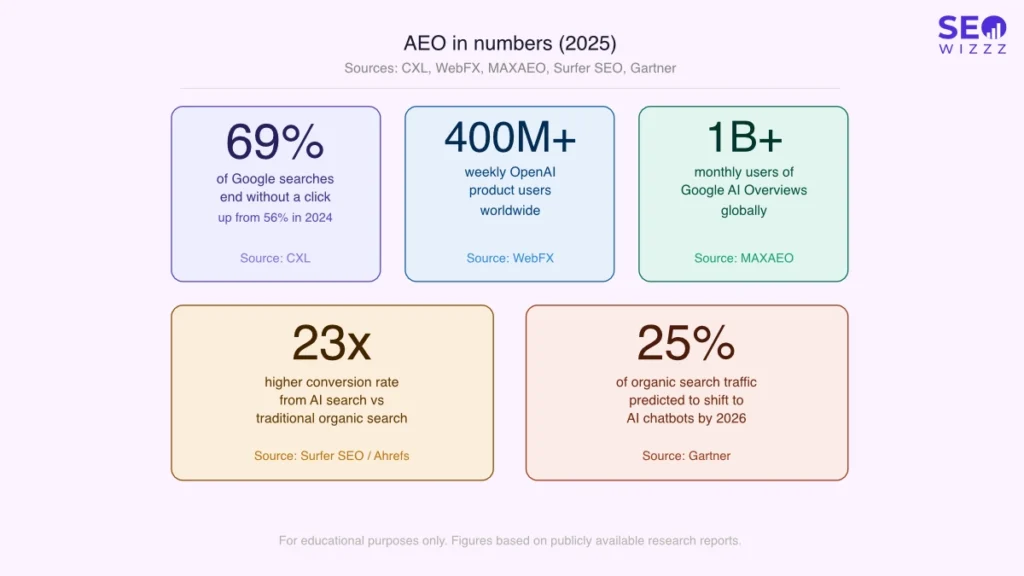
Truth be told! Because the numbers are impossible to ignore. According to CXL, the percentage of zero-click Google searches, where users get what they need without ever visiting a website, jumped from 56% in 2024 to 69% in 2025.
Current reports suggest that more than two-thirds of Google searches now end before anyone clicks a single link.
And AI adoption? It’s not a slow burn anymore; it’s now a bonfire. According to MAXAEO, Google’s AI Overviews are now used by over a billion people every month. That’s right, a billion.
Also Read: How BarRaiser Went to 60x Organic Leads Monthly?
AEO vs SEO: What’s the Difference, and Do You Have to Choose?
I’ll be honest with you here: You don’t have to pick sides. But you do need to understand how they’re different.
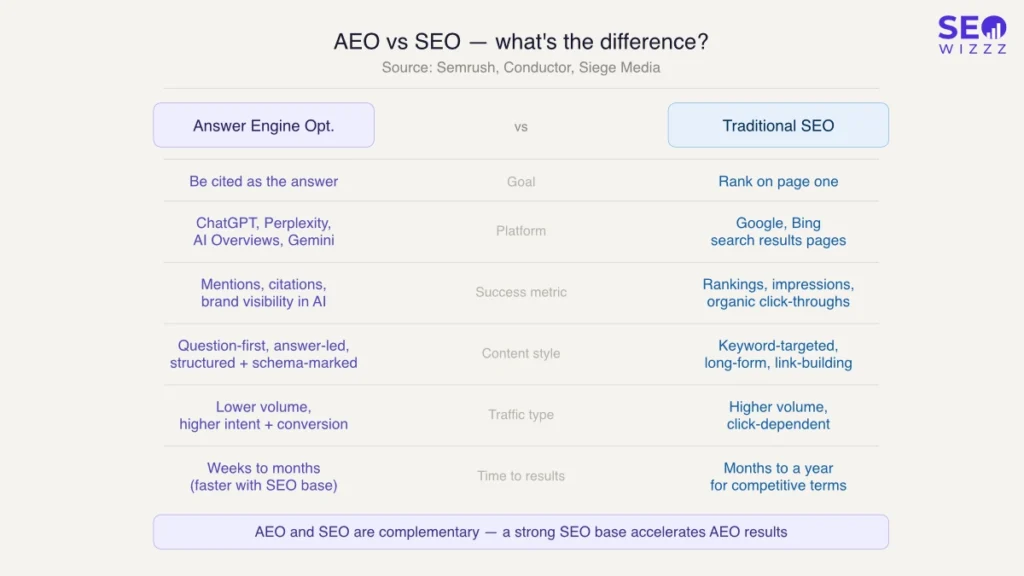
While traditional SEO focuses on ranking in Google’s top results, AEO ensures your brand shows up in the AI-driven answers people actually see. To keep it simple, SEO chases the click; AEO chases the citation. SEO measures rankings and impressions; AEO measures mentions, brand citations, and answer placements. They’re a kind of teammates who just have slightly different jobs.
Here’s a handy way to think about it:
- SEO = “Getting your book into the library”
- AEO = “Getting your book quoted in the librarian’s recommendation”
Despite all this, you need a solid SEO foundation and a prerequisite for effective AEO. Basic stuff like making your content crawlable, relevant, and authoritative will still do the job. Think of it as AEO building on top of SEO, not replacing it. Teams that invest in both are best positioned to show up wherever users ask questions.
Also Read: Avoiding Keyword Cannibalization: A Master’s Guide
Why AEO Matters for Your Business?
Line chart showing the rise of zero-click searches from 2020 to 2025, climbing from 50% to 69%.
The zero-click surge: why AEO can’t wait
% of Google searches ending without a user clicking any link
Sources: CXL (2025), SparkToro (2024), Adlift (2024). 2026 figure is a forward projection based on reported trend rates.
So, here’s the really interesting bit, and one that should shift how you measure content success. According to CXL, NerdWallet reported a 35% growth in revenue in 2024 despite a 20% decrease in website traffic.
Yes, you read that right.
Less traffic, more revenue, because their brand and expertise kept reaching consumers through AI-cited snippets and answer placements rather than direct clicks.
The takeaway here is not to panic about declining click-through rates; it’s to adapt your strategy so your brand still gets seen, cited, and trusted in the places where modern decisions are being made.
How to Actually Do AEO: 5 Things to Start Today
1. Answer the question first, explain second
This is the single most important shift in AEO writing. You see, AI systems favour content that follows a clear “answer first, explain later” structure: open every section with a concise 40–60-word direct answer, then use the rest of the section for context and depth.
2. Use question-based headings
Your H2 and H3 should reflect the way real people actually talk. This is important, you can’t stuff random non meaningfull keyowrd into the headline for the sake of keyword capture. And this is simple, LLMs strongly favour content that directly mirrors common search questions, structure your headings as questions and follow immediately with a clear answer, and that’s it.
3. Implement structured data
Schema markup is essentially giving search engines and AI a colour-coded map of your content. This is called maintaining hygiene. According to MAXAEO, AI Overviews feature lists in 78% of cases, and the most useful schema types for AEO include FAQPage, HowTo, and Article schema. If you haven’t set these up yet, this is your chance. Call your SEO guy, and get it fixed.
5. Earn citations and third-party mentions
AEO isn’t just about what’s on your website anymore; it’s about whether the wider internet trusts you. And this is going to be the most difficult part of the job right now. Somehting like guest posts, industry roundups, research studies that get referenced, and listings on credible directories. The more meaningful backlinks you have, the more AI systems will trust you.
Also Read: The Most Awesome Guide To Image SEO Optimization
6. Tap into E-E-A-T
Google’s E-E-A-T framework, Experience, Expertise, Authoritativeness, and Trustworthiness, isn’t going anywhere. In fact, it’s become even more critical for AEO, but you have to be creative now.
And I mean it, get a creative writer, not a content writer.
LLMs favour content that reflects real-world use, personal insights, and original research. Add author bios, cite credible sources.
(like this article is doing right now!)
And keep your content factually correct. You have to treat AI as an extremely picky editor, and it has a sixth sense for generic fluff, so don’t bluff with AI.
Also Read: 10 Quality Content Writing Secrets I learned the Hard Way
At the end:
There you have it, mark my word, Answer engine optimisation is a game-changing, traffic-disrupting, rules-rewriting glory. Because of this, the search landscape has fundamentally shifted, and the brands and creators who understand that being the answer is more powerful than ranking for a keyword are the ones who’ll thrive in this AI-first world.
A few things that you need to keep in mind are that you don’t need to throw out your existing SEO strategy and start from scratch. I’ll suggest starting with one high-intent, question-focused page. Apply the principles: answer first, structure clearly, cite credibly, earn mentions. Then keep going.
AEO typically takes a few weeks to a few months to show results, faster if you already have a solid SEO foundation in place.
Good luck. 🤞